Felidae
Editorially reviewedAfrican Wildcat
Felis lybica
The African wildcat is the small, tabby-striped ancestor of the domestic cat, widespread across Africa and southwestern Asia but increasingly diluted by hybridization.
The African wildcat is a small, solitary hunter that looks almost exactly like a domestic tabby. It has the same vertical pupils, the same striped coat, the same habit of freezing at a sound. The resemblance is not coincidence: this is the wild species from which the domestic cat descended, and the two still interbreed wherever their ranges meet.
It is also one of the most widely distributed wild cats, found from the Cape to the Caspian and into India and China. Yet it is rarely seen, rarely counted, and increasingly difficult to distinguish from the animal that shares its genes.
Names and taxonomy
The African wildcat is Felis lybica, described by Forster in 1780. For much of the twentieth century it was treated as a subspecies of the European wildcat, Felis silvestris, and many older sources still call it F. silvestris lybica . In 2017 the IUCN Cat Specialist Group's taxonomy revision recognized the wildcats of Africa and Asia as a separate species, F. lybica, with three subspecies: F. l. lybica in northern, eastern, and western Africa and Arabia; F. l. cafra in southern Africa; and F. l. ornata from southwestern and central Asia into India, China, and Mongolia .
The boundaries are not settled. The contact zone between lybica and cafra lies somewhere in the border region of southern Tanzania and northern Mozambique, but genetic sampling has not fixed it . The Chinese mountain cat, F. bieti, is treated as a separate species by some authorities and as a wildcat subspecies by others; genomic work places it within the wildcat group and finds gene flow with neighboring cats . The domestic cat's ancestor is likewise a population, not a point: F. lybica is the consensus species, but the exact mix of founding populations has not been reconstructed .
Range and habitat
Felis lybica has one of the broadest ranges of any small felid. It occurs across most of Africa, except closed tropical forest, and around the Arabian Peninsula into the Middle East, Central Asia, Pakistan, India, Mongolia, and western China . It is absent from true sandy deserts and humid tropical forest, but tolerates scrub, savanna, grassland, rocky hills, dry woodland, and agricultural land .
In deserts it follows watercourses, rocky outcrops, and mountain massifs; in the Sahara it has been recorded in the Ahaggar and Tassili N'Ajjer ranges . It reaches 3,000 m in places and uses aardvark burrows, rock crevices, and tree roots for cover . The species is adaptable, but it needs cover, prey, and freedom from persecution, and it does poorly where all three disappear.
Form and senses
An African wildcat is about the size of a large domestic cat. Adults typically weigh 2.7–5 kg, with a body 50–75 cm long and a tail of 21–35 cm . Males average larger than females. The coat is tawny, gray-brown, or sandy, marked with dark tabby stripes; the belly is pale, the legs are barred, and the back of each ear carries a rusty patch . The tail is slender and ringed, not bushy like a European wildcat's.
The face is broad, the ears are large and mobile, and the eyes are forward-set. Hearing is acute, and the whiskers detect the movement of prey and the width of a gap . The animal is built for a sudden rush rather than a long chase.
Distinguishing a wildcat from a feral tabby is genuinely difficult. The rusty ear patch, heavier build, longer legs, and banded tail are clues, not proof . Hybrids blur the picture further, which is why genetic sampling matters more than a field photograph.
Solitary life and diet
African wildcats are solitary and territorial. They scent-mark with urine and gland secretions, and they avoid one another outside the breeding season . They are almost entirely nocturnal, though they may be active at dusk and dawn, and they spend the day in a burrow, a rock crevice, or dense vegetation .
Home ranges vary with prey and habitat. In the southern Kalahari, females used about 3.5 km² and males about 7.7 km² . In the deserts of the United Arab Emirates, one radio-collared female ranged over 52.7 km², a reminder that a wildcat's map is drawn by water and food .
The diet is mostly small mammals, especially rodents, with lagomorphs important where available and birds, reptiles, amphibians, insects, and carrion taken opportunistically . Wildcats are patient stalkers. Around farms they take poultry and young lambs, which brings them into conflict with people and makes them targets for retaliation .
Reproduction and survival
Breeding is seasonal in much of the range. After a gestation of 56–68 days, a female gives birth to one to eight kittens, usually about three, in a den under rocks, in a burrow, or in dense cover . The kittens are born blind and helpless, open their eyes at about ten days, and are weaned at around a month. They stay with their mother for several months while they learn to hunt .
Females can breed at about ten to eleven months; males mature between nine and twenty-two months . In captivity, wildcats have lived up to about fifteen years, but wild longevity is poorly documented . Most mortality is unseen: disease, road traffic, larger predators, and people .
Domestication and hybridization
The domestic cat descends from Near Eastern populations of Felis lybica. Genetic analysis of 979 cats placed the origin in the Fertile Crescent, probably around the time of early farming, and identified at least five founding lineages . The relationship likely began as commensalism: wildcats hunted rodents around stored grain, people tolerated them, and selection favored animals that could live near humans without panic.
Ancient DNA shows the partnership spreading in waves, first with early farmers and later with trade and ships . Domestic cats reached Europe, Africa, and Asia along human routes, and wherever they went they met wildcats. The two can still interbreed, and they do.
Hybridization is now one of the wildcat's most insidious threats . It is widespread, though its intensity varies. In South Africa, genetic sampling found relatively pure wildcat populations but also detected hybridization that increased with human population pressure; protected areas held the purest animals . Domestic cats also compete for prey and space and can transmit disease .
The result is a conservation problem without a clean boundary. A wildcat that looks pure may carry domestic ancestry, and a hybrid may look wild. Protecting the species means protecting genetically distinct populations, not just individual cats.
Conservation and conflict
The IUCN lists Felis lybica as Least Concern, a status published in 2022 and based on an assessment from 2019 . The category reflects a very large range and a population that is stable in much of it, not a precise count. There is no global population estimate, and the trend is officially unknown .
The threats are cumulative. Habitat is converted for agriculture and settlement; wildcats are killed for poultry and lambs, caught in traps set for other animals, and struck by vehicles; some are hunted for fur or trophies . Free-ranging dogs kill them, and domestic cats compete with them and dilute their gene pool .
The species is listed on CITES Appendix II and is protected in many range countries, but enforcement is uneven . Large protected areas are a key defense against hybridization, because they keep domestic cats away from wild populations . An international studbook holds about sixty registered animals in twelve institutions, a small insurance policy for a species that is still common but nowhere secure .
The African wildcat is not a rare animal in the way a tiger is rare. It is a widespread animal that could quietly become something else — a wildcat in name, a hybrid in fact.
The margin
Sources
8 references · checked at publication
- 1Felis lybica (Afro-Asiatic Wildcat)
IUCN Red List of Threatened Species · Ghoddousi, A., Belbachir, F., Durant, S.M., Herbst, M. & Rosen, T. · 2022
- 2Felis silvestris (wild cat)
Animal Diversity Web, University of Michigan Museum of Zoology · Dewey, T. · 2005
- 3Southern African Wildcat (Felis lybica cafra)
Endangered Wildlife Trust · Herbst, M., Power, R.J. & da Silva, J.M. · 2025
- 4Genomic evidence for the Chinese mountain cat as a wildcat conspecific (Felis silvestris bieti) and its introgression to domestic cats
Science Advances (PubMed Central) · Yu, H. et al. · 2021
- 5The Near Eastern origin of cat domestication
Science (PubMed Central) · Driscoll, C.A. et al. · 2007
- 6Asian and African Wildcat Facts
Big Cat Rescue · 2026
- 7The palaeogenetics of cat dispersal in the ancient world
Nature Ecology & Evolution · Ottoni, C. et al. · 2017
- 8Genetic analysis shows low levels of hybridization between African wildcats (Felis silvestris lybica) and domestic cats (F. s. catus) in South Africa
Ecology and Evolution (PubMed Central) · Le Roux, J.J., Foxcroft, L.C., Herbst, M. & MacFadyen, S. · 2015
Image credits
- Bernard DUPONT · CC BY-SA 2.0 · source
Found a broken link or a claim that needs a better source? Use “Report an issue” above. Last checked October 21, 2026.
Provenance
How this entry was made
- Edition
- Seed edition
- Drafted with
- quanshu-seed-editor
- Prompt version
- seed-v1
- Reviewed
- October 21, 2026
This entry is part of QuanShu’s Animalia. Its claims are tied to the sources above; where the record is uncertain, the text says so. It has been checked against its cited sources and is open to correction. Read the editorial policy.
Continue reading
Related entries
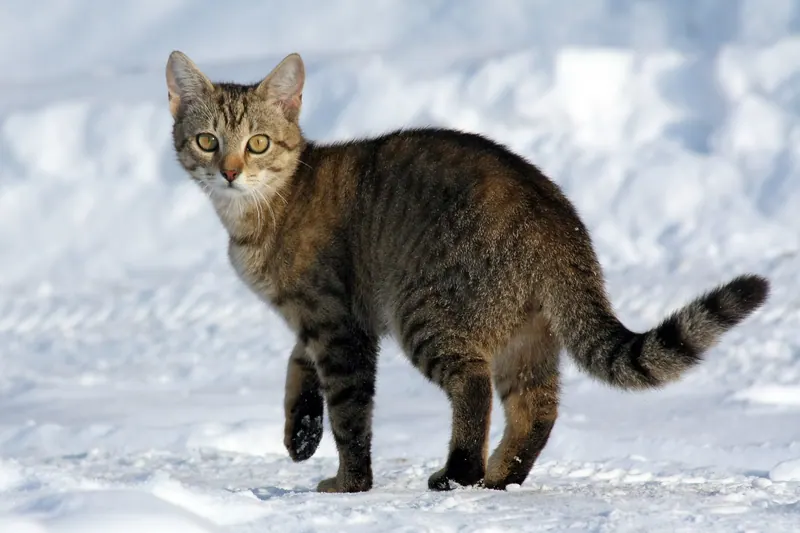
Felidae
Cat
The domestic cat is a small, solitary hunter that chose the human settlement — and then the human sofa. Its story is one of the least intentional domestications in history.
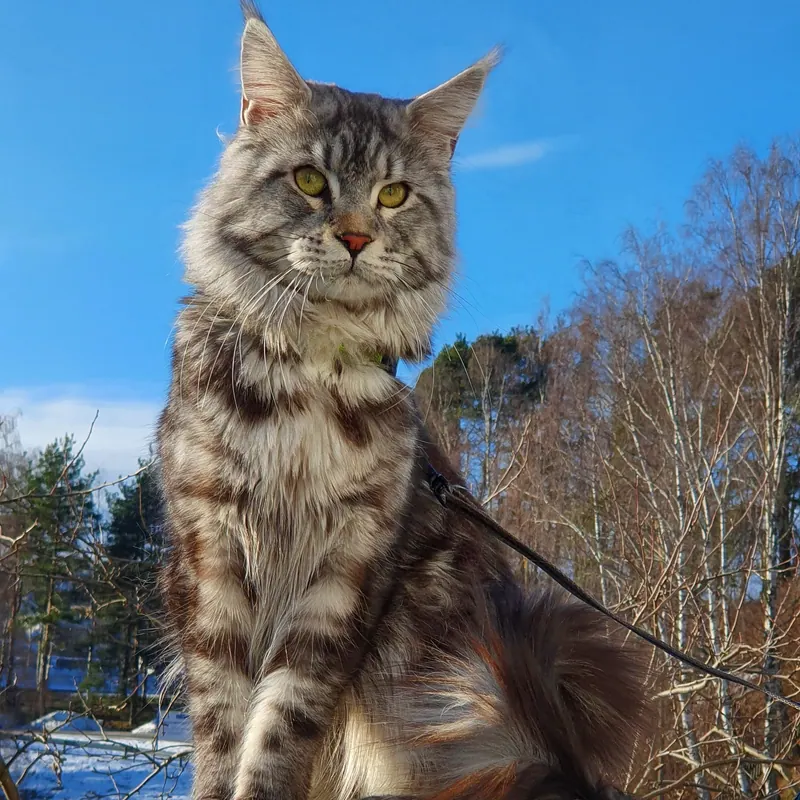
Cat breeds
Maine Coon
The Maine Coon is New England's native longhair: a large, slow-maturing cat with a shaggy coat, a sociable temperament, and inherited heart and joint conditions that breeders screen for.

Cat breeds
Siamese cat
A pointed, blue-eyed cat from Thailand, bred to a long wedge and a loud voice — and shaped by a small set of inherited risks that breeders now test for.