Felidae
Editorially reviewedCat
Felis catus
The domestic cat is a small, solitary hunter that chose the human settlement — and then the human sofa. Its story is one of the least intentional domestications in history.
The domestic cat is a small carnivore that lives, by its own accounting, on its own terms. It descends from the African wildcat, a solitary hunter of the Near East, and it began its association with people not as a pet but as a rodent catcher drawn to stored grain. Unlike the dog, the cat was never reshaped into a working partner on the same scale. It stayed close to the shape of its ancestor, and it kept the ancestor's independence.
That is part of the cat's peculiar appeal. It is a wild animal that has agreed to a household, a predator that purrs, a creature whose affection must be earned rather than commanded.
Names and taxonomy
The domestic cat is Felis catus, a member of the family Felidae and the genus Felis . Its closest wild relative is the African wildcat, Felis lybica, and genetic evidence points to the Near East as the place where the two lineages began to diverge . The older name Felis silvestris catus treats the cat as a subspecies of the European wildcat; modern usage generally separates the domestic cat at species level.
Taxonomy here is not just bookkeeping. It determines how conservation law treats free-ranging cats, how breeders describe pedigrees, and how scientists compare domestic populations with wild ones. The domestic cat is not a wildcat with a collar. It is a distinct human-associated population with its own history.
Origins and dispersal
Cat domestication is usually described as accidental. In the Fertile Crescent, roughly ten thousand years ago, wildcats began hunting rodents around early farming settlements. People tolerated them because they protected grain; the cats tolerated people because the grain attracted prey. Over generations, the boldest and least fearful animals gained an advantage, and a commensal relationship became a domestic one .
Ancient DNA shows the partnership spreading in waves, often with ships and trade routes . Cats traveled from the Near East into Europe, Egypt, and Asia, and later across the oceans. Egyptian art and burial practices show a particularly intense relationship, but the cat was already a companion and a pest controller long before it became a sacred animal. The Victorian era brought cat shows, studbooks, and the modern idea of a named breed .
Anatomy and senses
A cat is built for ambush. It has a flexible spine, powerful hind limbs, retractable claws, and a short digestive tract suited to a meat diet. Its eyes are large and forward-facing, adapted for low light, with a reflective tapetum that improves night vision. Cats are dichromats: they see blues and yellows but not the full human range of reds and greens.
Hearing is acute, extending well above the human range, and the whiskers are sensitive to air currents and close surfaces. The tongue's rough papillae help groom the coat and strip meat from bone. A cat's tail, ears, and pupils are expressive, but the animal is also a master of concealment. Much of cat behavior is designed not to be seen.
Behavior and communication
Cats are often described as solitary, but that is only half true. Wildcats hunt alone and defend territories, while domestic cats can form flexible social groups when food is abundant. Their social system is facultative: they can live alone, in a household, or in a colony, depending on resources and early experience.
The meow is largely a human-directed signal, and different cats develop different variants for different people. Purring can signal contentment, but also stress or self-soothing. Slow blinking is a sign of trust; a raised tail often signals a friendly approach. Play, scratching, and scent marking are not misbehavior but species-typical needs. A cat that is punished for scratching is being punished for being a cat.
Breeds and registries
The Cat Fanciers' Association and The International Cat Association recognize dozens of breeds, from the longhaired Persian to the nearly hairless Sphynx . The number depends on the registry and on how much variation a breed is allowed to contain. Some breeds are ancient landraces; others, such as the Bengal, were created in the twentieth century from crosses with wild felids.
Breed standards describe an ideal type, but they do not guarantee health. Breeding for extreme facial flatness, folded ears, or hairlessness can carry welfare costs. Pedigreed cats should come with health testing, and a registration paper is not a substitute for a veterinary examination. For most people, a healthy mixed-breed cat is an excellent choice.
Cats and people
For most of their history, cats were valued for pest control. They guarded granaries, ships, and warehouses, and they traveled with traders and sailors . Only in the last few centuries did companionship become their primary role in wealthy households. Today cats are among the most popular companion animals in the world, and their image circulates through art, literature, and the internet with a force that would have astonished a Near Eastern farmer.
Living with a cat means respecting an animal that is both social and solitary. Cats need scratching surfaces, vertical space, hiding places, and predictable routines. They benefit from play that mimics hunting and from choice about when to be touched. A cat is not a small dog, and it is not a decoration.
Health and lifespan
Indoor cats commonly live twelve to eighteen years, and many reach their late teens or early twenties. Preventive care matters: vaccination, parasite control, dental care, weight management, and regular veterinary examinations . Cats are skilled at hiding illness, so subtle changes in appetite, litter box use, grooming, or activity deserve attention.
Obesity is common and linked to diabetes and joint disease. Kidney disease, dental disease, hyperthyroidism, and heart disease become more likely with age. Flat-faced breeds may have breathing difficulties; folded-ear breeds are predisposed to cartilage disorders. A good life includes mental stimulation, safe outdoor access where appropriate, and careful attention to the cat's own preferences.
Conservation and outdoor life
Free-ranging cats are efficient predators, and outdoor cats can kill birds, small mammals, reptiles, and amphibians . The scale of that impact, and the best response to it, is debated. Keeping cats indoors or in secure outdoor enclosures protects wildlife and reduces the risk of traffic injury, poisoning, and infectious disease. Sterilization and identification reduce free-ranging populations and help reunite lost animals with their people.
The ethical question is not whether cats should exist, but how people should keep them. A cat is a predator with a claim on our care and a place in an ecosystem that did not evolve with it. Good ownership holds both facts together.
The margin
Sources
9 references · checked at publication
- 1Cat
Encyclopaedia Britannica · 2026
- 2The Near Eastern origin of cat domestication
PNAS · Driscoll, C. A. et al. · 2007
- 3The palaeogenetics of cat dispersal in the ancient world
Nature Ecology & Evolution · Ottoni, C. et al. · 2017
- 4Cat breeds
Cat Fanciers' Association · 2026
- 5Cat care
American Society for the Prevention of Cruelty to Animals · 2026
- 6Cornell Feline Health Center
Cornell University College of Veterinary Medicine · 2026
- 7The cat's meow: How cats conquered the world
Smithsonian Magazine · 2018
- 8Comparative analysis of the domestic cat genome reveals genetic signatures underlying feline biology and domestication
PNAS · Montague, M. J. et al. · 2014
- 9Cat owners
MSD Veterinary Manual · 2026
Image credits
- Von.grzanka · CC BY-SA 3.0 · source
Found a broken link or a claim that needs a better source? Use “Report an issue” above. Last checked October 21, 2026.
Provenance
How this entry was made
- Edition
- Seed edition
- Drafted with
- quanshu-seed-editor
- Prompt version
- seed-v1
- Reviewed
- October 21, 2026
This entry is part of QuanShu’s Animalia. Its claims are tied to the sources above; where the record is uncertain, the text says so. It has been checked against its cited sources and is open to correction. Read the editorial policy.
Continue reading
Related entries
Felidae
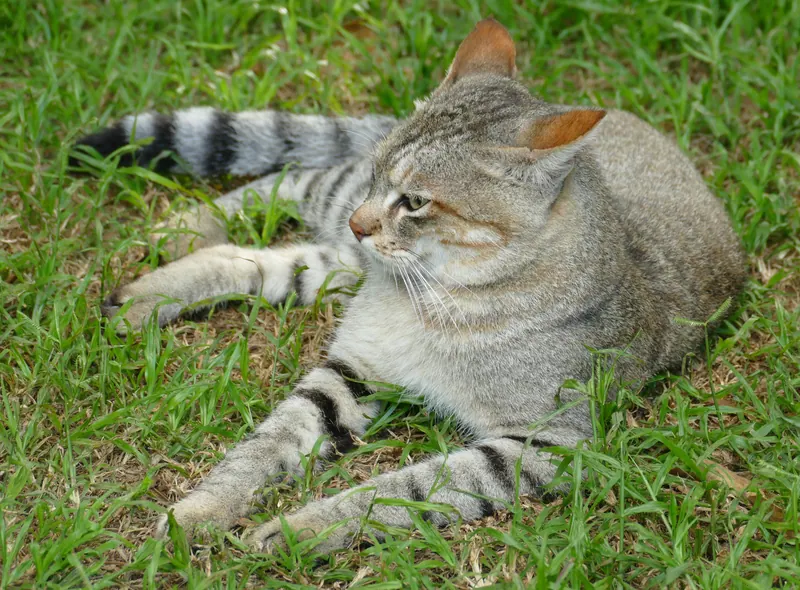
African Wildcat
The African wildcat is the small, tabby-striped ancestor of the domestic cat, widespread across Africa and southwestern Asia but increasingly diluted by hybridization.
Cat breeds
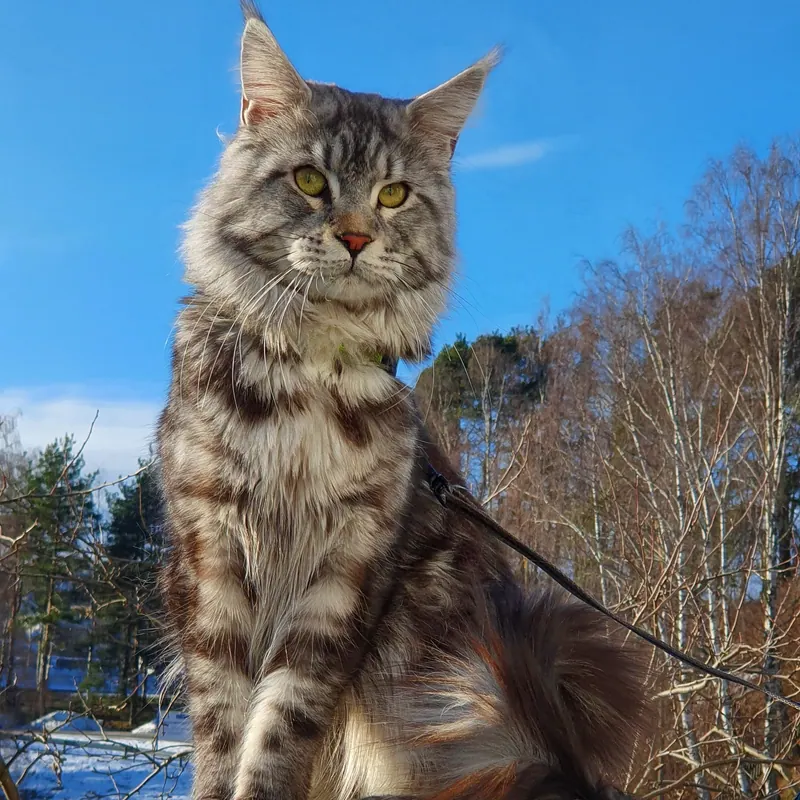
Maine Coon
The Maine Coon is New England's native longhair: a large, slow-maturing cat with a shaggy coat, a sociable temperament, and inherited heart and joint conditions that breeders screen for.
Cat breeds
Siamese cat
A pointed, blue-eyed cat from Thailand, bred to a long wedge and a loud voice — and shaped by a small set of inherited risks that breeders now test for.